
What laminate installation costs
The same question for a laminate floor: the board, the underlay, the subfloor and the building.
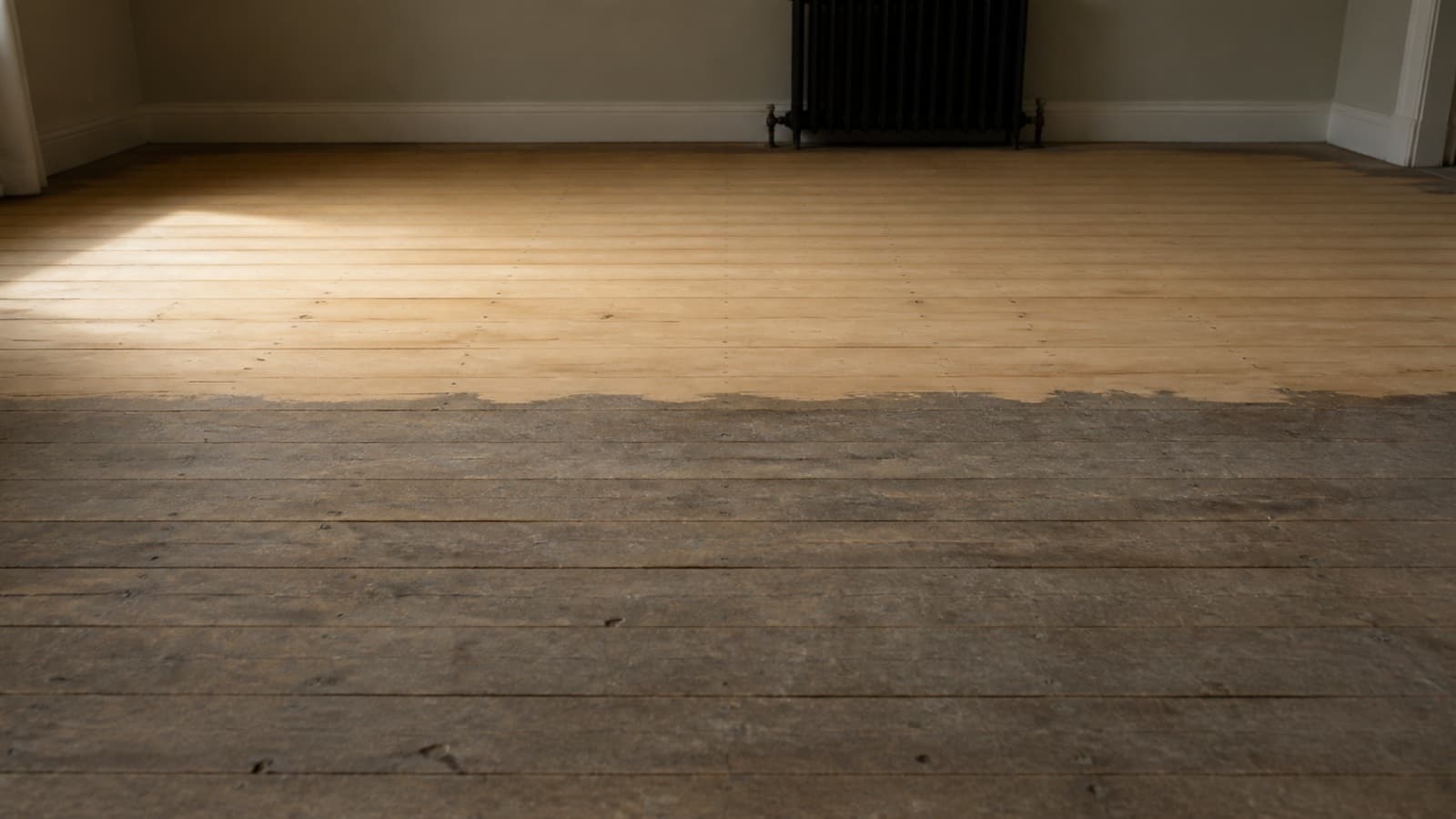
There is no single price for a floor, and anyone quoting one before seeing yours is guessing. What follows is what actually moves the number, so you can read a quote and know whether it makes sense.
Two floors of the same size can be very different jobs. One has been looked after and needs a light sand and two coats. The other has water damage in one room, three boards missing, a threshold that was never finished properly, and a stair run that has to be done by hand.
The second floor takes longer, uses more material and needs more skill, and no honest number covers both. That is why a real quote follows a look at the floor rather than a phone call.
What you can do before anyone visits is work out which of the things below apply to you. If you can describe those, you will get a much closer answer much faster.
In roughly the order they matter on a typical job.
The single biggest factor. More square footage means more sanding, more finish and more days. It is also why a quote per room is less useful than a quote for the actual area.
A sound floor takes one pass sequence. Deep scratches, pet stains that have gone through into the wood, cupping from water, or old adhesive all add work before finishing can start.
Stairs are slow. They are sanded largely by hand, every tread and riser is a separate surface, and a flight can take as long as a room. If you have stairs, say so early.
An empty floor is quicker and cheaper than one that has to be worked around. If we move and protect furniture, that is time on the job.
Finishes differ in price, in how many coats they need, in how long each takes to cure, and in how hard wearing they are. A finish that lets you back on the floor sooner usually costs more per gallon.
More coats means more material and more drying time between them. On a floor that takes heavy use it is money well spent, and on a quiet bedroom it may not be.
Access matters too. A sixth floor walk up with no service elevator changes how long it takes to get machines and material in and out, and that is time like any other.
Know your rooms and rough area? Tell us and we will tell you what your job depends on.
Call (929) 207-0351This is the other half of the cost question, and it is usually decided by the wood rather than by the budget.
The boards are solid, there is enough thickness left above the tongue to sand, and the damage is in the finish rather than in the wood. This is most floors. You keep the floor you already own and it comes back looking new.
The boards have been sanded so many times that there is nothing safe left to take off, water has cupped or split them badly across large areas, or too much of the floor is simply missing. At that point sanding cannot rescue it.
We look at thickness at a threshold or a vent where the edge of a board is visible, check how the boards have moved, and look at what is underneath. It is a measurable check rather than a matter of opinion.
If the wood is sound and only the finish is tired, a buff and recoat puts a fresh coat on without sanding. It costs less, takes less time and is worth asking about before committing to a full sand.
A solid wood floor can normally take several sandings across its life. What limits it is the thickness of wood above the tongue, because once a sander reaches that, the boards are finished.
Engineered wood is different. It has a real wood wear layer over a stable core, and how many sandings it has left depends on how thick that layer is. Some engineered floors can be sanded more than once and some cannot be sanded at all.
This is why the same question gets different answers in different apartments. It is worth knowing which kind of floor you have before you plan around it.
Not sure how much life your floor has left? Send a photo of a threshold and we will tell you.
Call (929) 207-0351It is a fair question and the honest answer is that you can. Sanders are available to rent and the finishes are sold to anyone.
Two things catch people out. A drum sander cuts fast, and if it stops moving while the drum is down it will take a dip out of the floor that then has to be sanded flat again. And finish shows everything, so lap marks, dust and a brush that stopped mid room all stay visible once it dries.
On a single small room in a house, it is a reasonable weekend project. On a large open floor, on stairs, or in a building with rules about hours and elevators, the repair bill when it goes wrong is usually larger than the saving.
Four steps, and the first one you can do today.
Length by width of each room is enough. It does not need to be exact, it needs to be close.
The area you like least tells us more than the area you like most. Include a threshold or a floor vent if you can, because the edge of a board shows thickness.
Stairs, furniture, pets, the floor you live on, whether there is a service elevator, and anything your building has already told you about hours or approvals.
Which job the floor needs, what it depends on, and the sequence. Including when the answer is the cheaper job.
Two narrower questions answered on their own pages, and the way to a real number.
The same question for a laminate floor: the board, the underlay, the subfloor and the building.
The finish is one of the six things that move the number. How the two compare.
Send the rooms and the rough area and get a straight answer back.
Send the rooms, the rough area and a photo of the worst part. We will tell you which job it needs and what it depends on.