
Laminate flooring installation
What laminate is, what goes under it, and where it belongs.
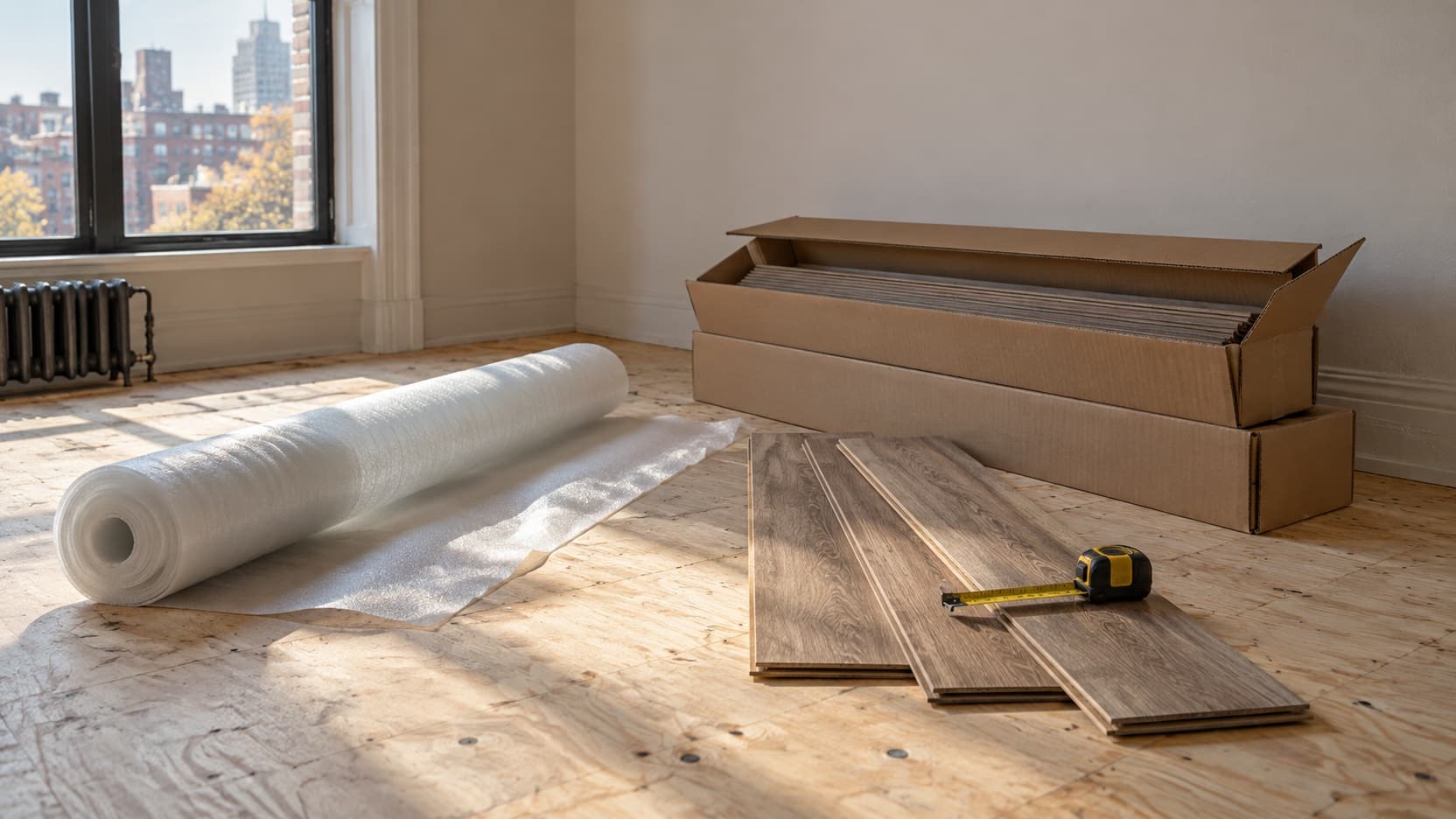
Laminate is one of the least expensive floors to buy and one of the fastest to fit. What you pay for a finished floor still depends on your rooms, your subfloor and your building, so here is what actually moves the number.
Cost guides quote a range per square foot, and the range is built from jobs across the whole country. A New York job is not an average job. The boxes may be carried up five flights, the work may have to fit inside a building's permitted hours, and the old floor has to leave the building the same way the new one came in.
None of that changes what laminate is. It changes how long the job takes and how much preparation sits underneath the part you can see, and those two things are what the number is made of.
So rather than a figure that will be wrong for your floor, here is the list of what decides it. If you can answer most of these, you will get a close number quickly.
Roughly in the order they matter on a typical job.
Area first, then the shape of it. A long corridor, several doorways and an L shaped room mean more cuts and more waste than one open rectangle of the same size, and every doorway is a transition strip that has to be fitted.
Laminate is graded by how hard the wear layer is and how thick the board is. A thicker board with a higher wear rating costs more per box and feels more solid underfoot. Boards with the underlay already attached cost more and save a step.
Laminate floats on underlay, and over concrete it needs a moisture barrier as well. Good underlay is the difference between a floor that sounds hollow and one that does not. It is a small share of the bill and the wrong place to save.
A floating floor bridges dips and the joints take the stress. Anything beyond a small tolerance gets levelled before the first plank goes down. A flat subfloor adds nothing to the number. An uneven one adds compound, time and drying.
Carpet comes up quickly. Glued vinyl, old tile or a nailed wood floor take longer and leave more to clear. The old floor also has to be bagged, carried out and disposed of, and in an apartment building that is real time.
Beading or skirting to cover the expansion gap, a transition strip at every doorway, and stair nosings if the floor runs onto a landing or a staircase. Stairs in laminate are slow, because each step is fitted separately.
Furniture matters too. An empty room is fitted in one run. A room we have to clear and refill is the same floor plus the moving.
The part no square footage number includes.
Laminate arrives in heavy boxes. A service elevator that has to be booked, a passenger lift with protection rules, or a walk-up with no lift at all each make a different morning, and the boxes go up before a single plank is fitted.
The city sets an outer limit on when work can happen and most buildings set a tighter one. A shorter working window does not change the job. It changes how many days the job is spread across.
Lobbies, corridors and lifts are covered while material moves through, and uncovered again at the end. It is part of the job and we bring it with us.
In a co-op or condo the board usually wants to know what is being done before it starts. That costs time rather than money, and it is the first conversation to have rather than the last.
Know your rooms and rough area? Tell us and we will tell you what your laminate job depends on.
Call (929) 207-0351With a real wood floor the boards are a large share of the bill. With laminate they usually are not. The board is inexpensive and fits fast, so the underlay, the preparation, the trims and the access end up a bigger share of the total than people expect.
That is also why two quotes for the same room can differ. A quote that includes levelling, a moisture barrier and disposal of the old floor is a different quote from one that does not, so it is worth knowing what yours includes before comparing it with another.
The material is only cheaper if it is the right material for the room.
This is where laminate earns its keep. Hard wearing, quick to fit, and no finish to cure at the end, so the room is back in use the same day.
Standing water swells a laminate core. In these rooms vinyl plank is the right material, and a laminate floor that has to be replaced after a leak was never the cheap option.
A real wood floor costs more to buy and can be sanded and refinished for decades. Laminate cannot be sanded, so when the wear layer goes the floor is replaced. Over a long enough stay the wood floor can be the better value.
Four things, and the first three you can do today.
Length by width of each room, and count the doorways. Close is good enough.
Carpet, vinyl, tile or wood, and whether it is glued or nailed. This decides the removal.
Which floor you are on, whether there is a service elevator, and what your building has said about hours.
The subfloor, the moisture and the layout, and then a number for your floor rather than an average of everyone else's.
On the material, yes, because you are not paying for the fitting. Click laminate is designed to be laid by hand and plenty of people do a bedroom over a weekend.
Where it goes wrong is the preparation and the edges. An unlevelled subfloor, no expansion gap, or a moisture barrier left out shows up months later as lifting joints, and the repair usually costs more than the fitting would have. In a shared building the access and the hours add a second layer of difficulty.
Yes, unless the board has it attached already. Underlay evens out small imperfections, takes the hollow sound out of a floating floor and cushions the joints.
Over concrete a moisture barrier goes down as well. Skipping either is the cheapest saving on the list and the most expensive one to reverse.
A straightforward room usually goes down in a day, and there is no curing time afterwards because there is no finish to dry.
What stretches it is preparation, removal of the old floor, many doorways, stairs, and the hours your building allows. We tell you the sequence at the estimate.
The pages behind this one.
What laminate is, what goes under it, and where it belongs.
The same question for wood floors, and whether to refinish or replace.
The right material where water rules out laminate.
Send the rooms, the rough area, what is down now and which floor of the building you are on. We will tell you what your job depends on, and then a real number once we have looked.