
Oil or water based polyurethane
The finish choice, compared plainly, and what a shared building changes about it.
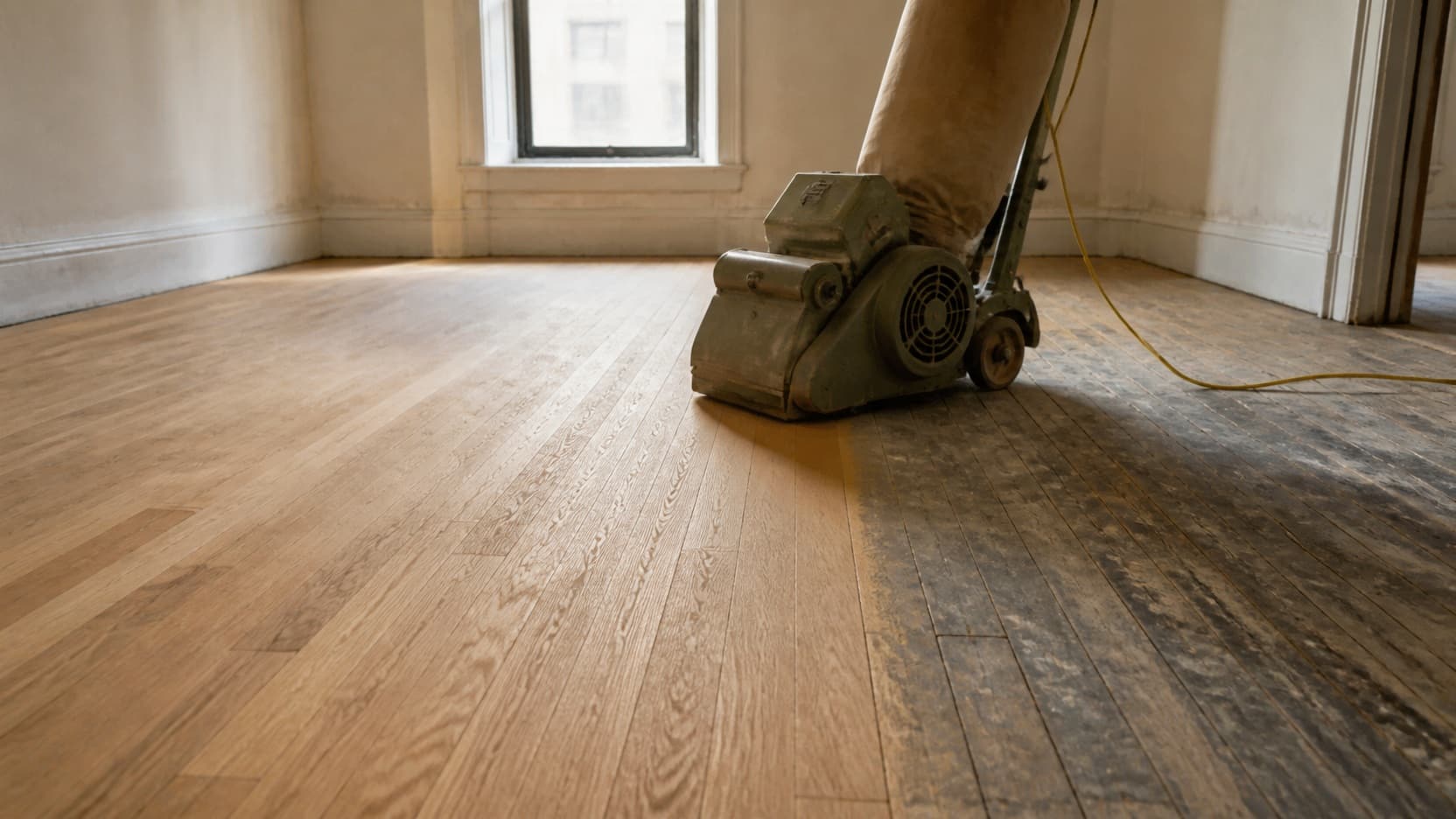
We sand wood floors back to bare timber and finish them again, in apartments and houses across all five boroughs. It is the job that makes an old floor look new without replacing it.
Refinishing means sanding the floor back to bare wood and putting a new finish on it. Floor sanding and floor refinishing are the same job. Sanding is the part that takes the old surface off, and the finish is what protects the wood afterwards.
It works because a solid wood floor is thick. The part you walk on is a wearing surface, and there is usually more of it left than people assume. Taking a fraction of a millimetre off removes the scratches, the grey, the pet stains and the old finish all at once.
What comes back is the wood you already own, in the colour you choose. That is why refinishing is almost always cheaper than replacement when the boards are sound.
Three different jobs, three different prices. Most people who ask for one of these actually need another.
For a floor that is grey, scratched through the finish, stained into the wood, or patchy from previous work. Everything comes off and the floor starts again. This is the job that changes how a room looks.
For a floor that is dull but sound, where the finish is tired and the wood underneath has not been reached. No sanding, one fresh coat, far less disruption and far less cost. Always worth asking about before committing to a full sand.
For damage in one area rather than wear across the whole floor. Boards are replaced and blended, and the repair is finished with the rest so it reads as one floor.
We tell you which one your floor needs, including when it is the cheaper one. A recoat instead of a full sand is a smaller invoice, and it is the right answer often enough that it is always checked first.
Not sure which of the three your floor needs? Send a photo and we will tell you.
Call (929) 207-0351The signs people describe when they call, and what each one usually means.
Grey means the finish has worn through and the bare wood is taking the traffic. Once that happens the wood is absorbing whatever lands on it. This is the point where sanding is the answer rather than a recoat.
If a scratch catches your nail it is in the wood, not just the finish, and a coat over the top will not hide it. If it does not catch, a recoat may well be enough.
That is staining that has gone through into the timber. Sanding removes most of it. Deep black marks sometimes remain and are usually better addressed by board replacement in that spot.
Moisture. Sanding a floor that is still moving locks the shape in, so the sequence matters more than the speed. We check moisture before anything starts.
Parquet is common in this city and it refinishes well. The blocks are usually solid wood, and where they are sound the whole floor can be sanded and finished like any other.
Two things differ. Parquet is sanded across the grain in more than one direction, which is slower and needs more care to avoid scratch patterns. And loose or missing blocks are lifted and re-laid before sanding rather than after.
A parquet floor that looks beyond saving very often is not. It is worth having someone look before deciding to cover or replace it.
Once the floor is bare, the colour is a decision rather than a fact. The same boards can finish natural, warmer, or considerably darker depending on the stain.
We put sample patches down on your own floor before committing. Stain behaves differently on different timbers and on different ages of wood, so a colour chart is a starting point and your floor is the real test.
The finish itself matters as much as the colour. Finishes differ in sheen, in how hard wearing they are, in how many coats they need and in how long each takes to cure. A finish that lets you back on the floor sooner usually costs more per gallon, and on a busy home that is often money well spent.
Want to see colour options on your own floor? We put sample patches down before anything is committed.
Call (929) 207-0351Sanding makes dust. What has changed is where it goes. Our machines run with dust extraction that takes most of it at the source rather than letting it settle through the apartment.
We also seal off the rooms that are not being worked on, and we clean up rather than leaving it. It is not a dust-free process and nobody should promise that, but it is a long way from what floor sanding used to mean.
In a shared building this matters to your neighbours as much as to you, which is part of why the schedule is planned around the building rather than against it.
A typical full refinish, in order.
Condition, timber, how much thickness is left, moisture, and what the building requires. This is what turns an estimate into a number.
Furniture out or moved and protected, adjoining rooms sealed, shared parts of the building covered on the way in.
Coarse through to fine, then the edges and corners by hand. This is the loud part and it happens inside your building's permitted hours.
Sample patches first, then the whole floor once you have chosen.
Coats with drying time between them. The wait at the end is the finish curing, not us working. We tell you when you can walk on it and when furniture can come back.
Ready to get your floor looked at? Send the rooms and a photo of the worst part.
Call (929) 207-0351Floor area first, then the condition of the wood, the number of rooms, stairs, whether furniture has to move, the finish you choose and how many coats it needs.
We do not quote a floor over the phone, because two floors of the same size are routinely different jobs. What we can do on the phone is tell you which of those things applies to you and what it will drive.
There is a fuller breakdown of what moves the number, and of the refinish-or-replace decision, on the costs page.
It depends on the finish. Water based polyurethane is dry enough for the next coat in a few hours and takes light foot traffic in socks the next day. Oil based polyurethane needs overnight between coats and a day or two before careful walking.
Full hardness is a different thing. With either finish the floor keeps curing for days to weeks, so rugs and heavy furniture wait longer than feet do. We tell you both dates at the estimate so you can plan where to sleep and when to move things back.
Oil based warms the wood and needs overnight between coats. Water based stays clear, dries in hours and smells far less, which matters in a shared building. Both wear well on a properly sanded floor.
There is a full comparison on the finish page, and we put sample patches on your own floor before committing to either.
The pages people read next.
The finish choice, compared plainly, and what a shared building changes about it.
What moves the number, and whether to refinish or replace.
When the problem is damage in one area rather than wear everywhere.
Send the rooms, the rough area and a photo of the worst part. We will tell you whether it needs a sand, a recoat or a repair.