
Hardwood floor refinishing
When the complaint is the whole floor rather than one area.
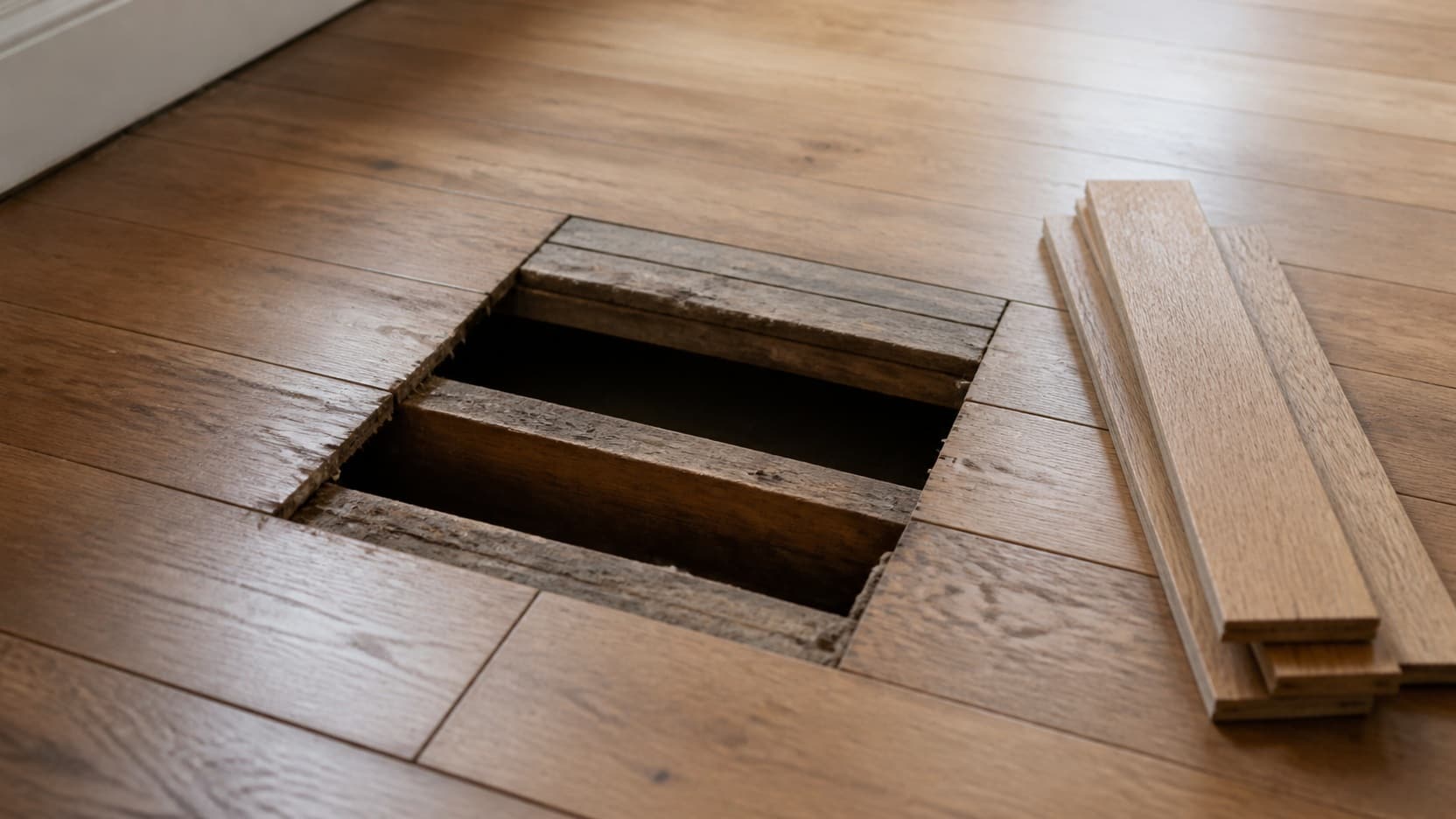
We repair wood floors across all five boroughs, from a few damaged boards to a room that has taken water. A damaged area rarely means replacing a whole floor.
People often call expecting to be told the floor is finished. Usually it is not. Individual boards can be lifted out and replaced, and the repaired area is then sanded and finished with the rest so it reads as one floor rather than as a patch.
What makes that work is matching. Board width, thickness, species and grain direction all have to line up, and older floors sometimes need boards sourced or cut to match rather than bought off a shelf.
The judgement worth paying for is knowing when a repair will disappear and when it will always show.
Four common kinds of damage, and what each one usually turns out to be.
A leak, an appliance, a radiator or a neighbour upstairs. Boards swell and cup across their width. The important thing is not to rush: a cupped floor often flattens considerably as it dries, and how much replacement is really needed only becomes clear once it has. We check moisture and tell you whether to wait.
Almost always fixings rather than the boards. Movement between the board and the joist, or between the subfloor and the joist, is what makes the noise. It is fixed from above where we can get at it, and it is usually a much smaller job than people fear.
Failed adhesive or failed fixings, and on parquet it is loose blocks. They are lifted, the base is cleaned back, and they are re-laid properly. Hollow-sounding areas usually mean the board is no longer in contact with what is under it.
Gaps open and close with the seasons and are worth watching across a year before filling. Deep gouges and burns are board replacements rather than fillers, because filler in a high traffic line will always show.
Send a photo of the damage and we will tell you whether it is a repair or something bigger.
Call (929) 207-0351Sometimes the boards are fine and the subfloor is not. A floor that dips, bounces or feels soft is telling you about what it is fixed to rather than about itself.
That means lifting a section to look. Subfloor repair and levelling are their own work, and doing them properly is what stops the same complaint returning a year later.
It is also the honest reason a repair quote sometimes changes once we are in. We say so before starting rather than after.
Repair is the right answer more often than people expect, and the wrong one sometimes.
Damage in one area, sound floor everywhere else. Boards replaced and blended, then finished with the rest.
Wear across the whole floor rather than damage in one place. If the complaint is how the floor looks overall, sanding is the answer and a repair will not change it.
Too little thickness left to sand again, damage across large areas, or a floor that has already been repaired repeatedly. At that point new boards cost less than chasing it.
A repair and a refinish are often done together. Fixing the damage and then sanding the whole floor is what makes a repaired floor stop looking repaired.
Not sure which of the three yours needs? Send a photo and we will tell you.
Call (929) 207-0351Four steps, and the first is free.
For a contained repair a clear photo often tells us most of what we need. Include something for scale.
There is no point replacing boards under a leak that is still leaking, or refixing a squeak whose cause is below.
Damaged boards out, base checked and cleaned, matched boards in and fixed the way the floor was built.
Sanded and finished into the surrounding floor. On an older floor with a worn finish, blending the whole room is often what makes the repair invisible.
The pages people read next.
When the complaint is the whole floor rather than one area.
What moves the number, and whether to refinish or replace.
All five boroughs, the site that covers each one, and the building side of the job.
A photo of the damaged area and roughly where it is in the room. We will tell you what it is and what it takes to put right.