
Laminate flooring
For dry rooms where hard wearing matters most.
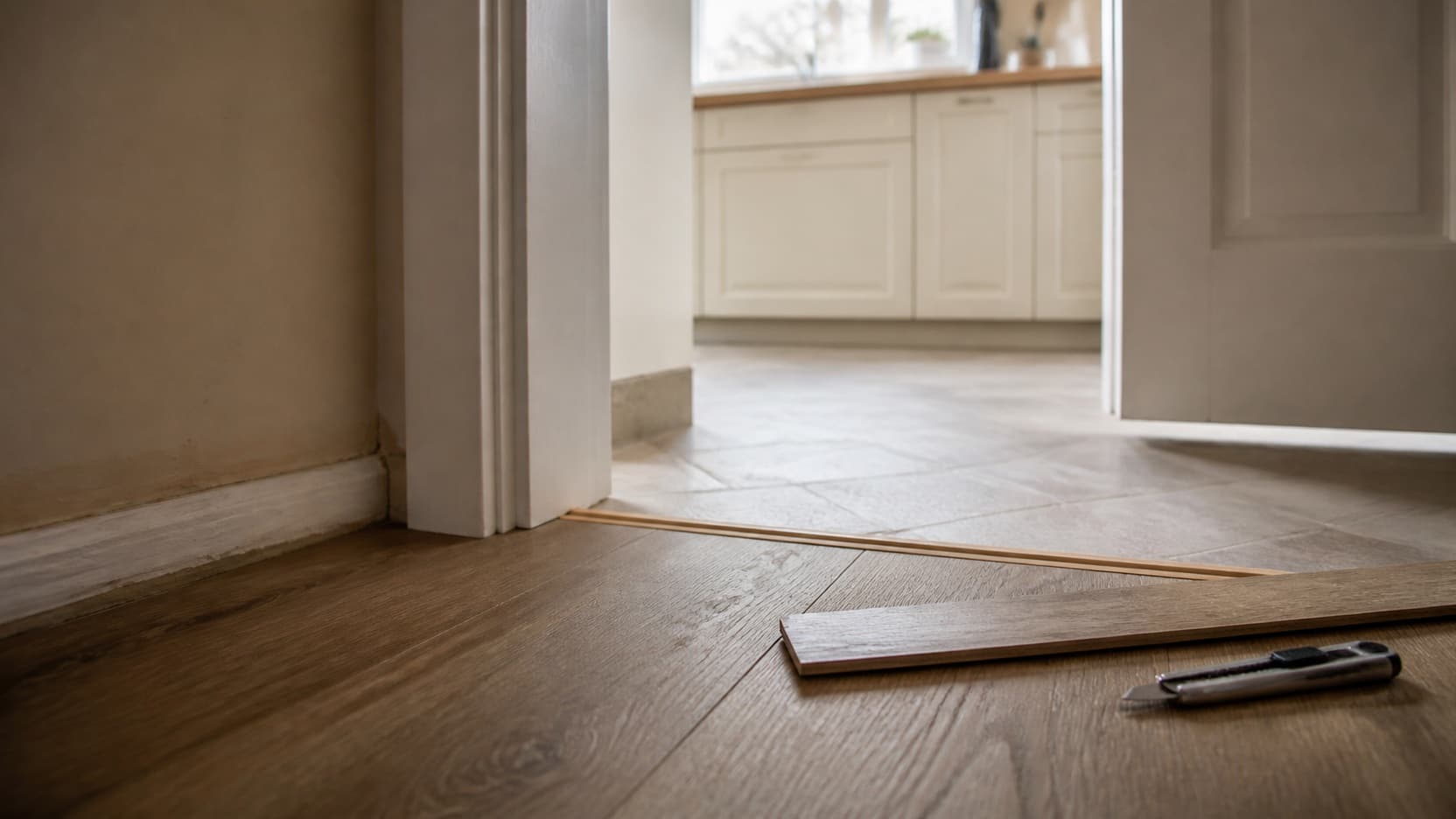
We fit luxury vinyl plank across all five boroughs, in kitchens, bathrooms, basements and below grade. It is the floor that does not mind water.
Luxury vinyl plank is a wood-look floor with no wood in it. That sounds like a compromise until you put it somewhere wet, which is exactly where every other wood-look floor fails.
Wood swells. Laminate's fibreboard core swells faster. Vinyl does neither, so a leak under a dishwasher or a wet basement floor is an inconvenience rather than a replacement.
It is also warmer and quieter underfoot than tile, which is what makes it the usual answer for a kitchen that connects to a living room.
Four rooms where we recommend it over wood or laminate.
Spills, dishwashers, fridges and sinks. A kitchen floor gets water on it regularly, and vinyl plank is the one wood-look floor that treats that as normal.
Standing water and constant humidity. Wood and laminate are both wrong here, and vinyl plank gives you the look without the risk.
Moisture comes up through a slab whether you can see it or not. Vinyl plank does not care, which is why it is the default below grade in this city.
Hard wearing, easy to clean, and a damaged plank can often be lifted and swapped without touching the rest of the floor.
Kitchen, bathroom or basement? Tell us the room and we will tell you what suits it.
Call (929) 207-0351Two ways to fit it, and the room usually decides which.
Planks lock together and float over an underlay. Faster, no adhesive, and forgiving if a plank ever has to come up. Needs a reasonably flat base and a perimeter expansion gap.
Bonded to the subfloor. The most solid underfoot, the best in very large rooms and under heavy rolling loads, and the better answer where temperature swings are wide. Needs a flatter, cleaner base and more preparation.
Vinyl plank is thin, so it follows what is underneath rather than bridging it. Dips and ridges telegraph through into the finished floor, which is why levelling is usually the real work in a vinyl job.
Wear layer thickness is the number worth asking about. It is what decides whether a floor looks the same in five years, and it varies far more between products than the price does.
The common objection is that vinyl looks cheap. That was fair once and it is largely out of date. Current products are embossed in register, which means the texture you feel lines up with the grain you see, and the plank sizes and colour variation are far closer to real timber than they were.
The way to judge it is in person and in daylight rather than from a photograph. We bring samples to the room they are going in, because a kitchen with one window shows a floor very differently from a showroom.
If real wood is what you want and the room allows it, we will tell you that too.
Floor area, the product and its wear layer, how much levelling the subfloor needs, click or glue, the number of doorways and cuts, and whether an old floor has to come out.
Levelling is the item that most often moves a vinyl quote, because the floor is thin and the base has to be right. It is worth knowing that before comparing two numbers that look different.
The costs page has the full breakdown.
The pages people read next.
For dry rooms where hard wearing matters most.
Where the room allows real wood and it is worth the difference.
What moves the number across every kind of floor.
Tell us the room, the rough area and what is under the floor now. We will tell you whether click or glue suits and what the base needs.